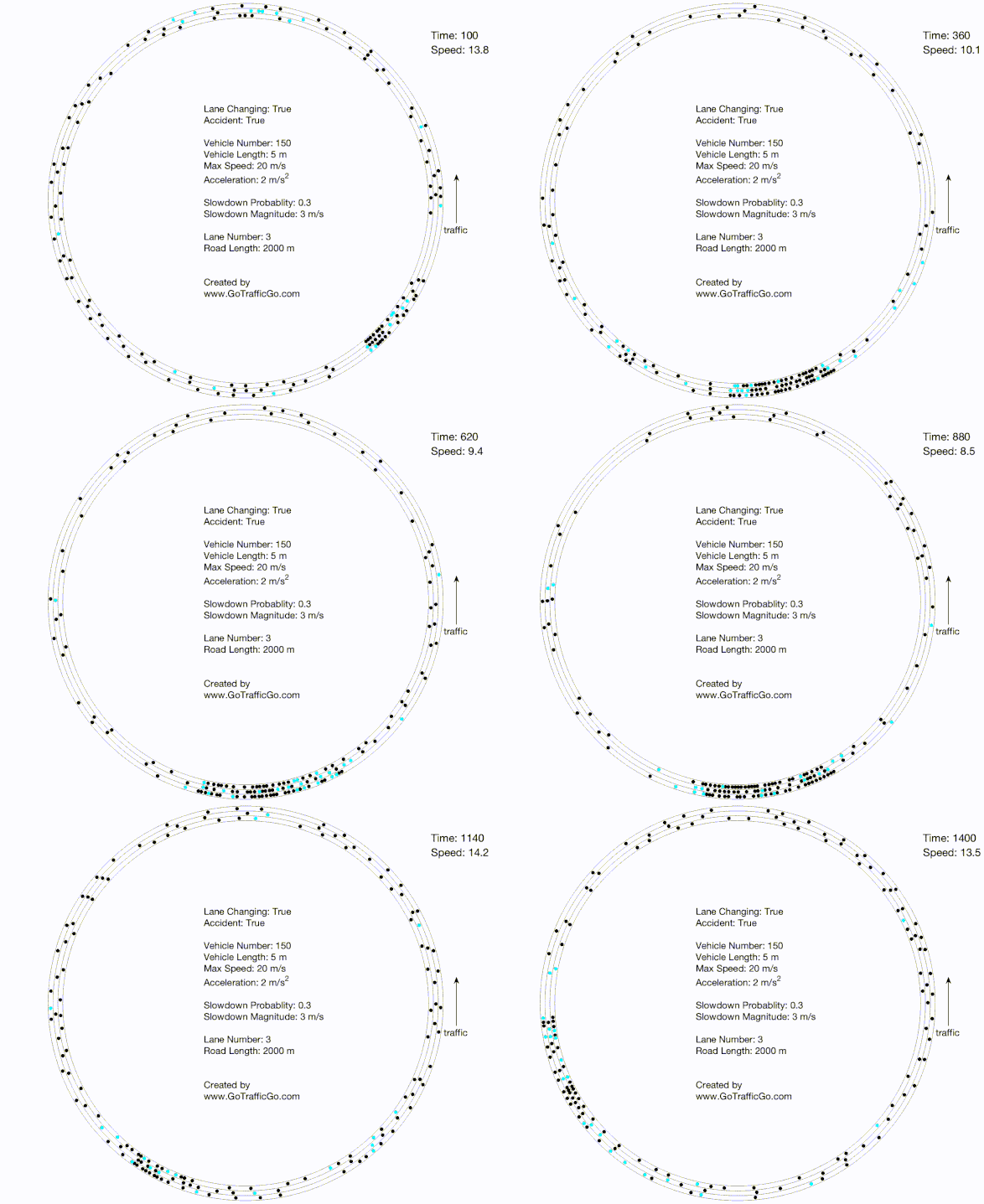
Traffic Flow Theory (CIVE5490, Department of Civil & Environmental Engineering at the University of Massachusetts Lowell, 2024–2025) is a foundational course that focuses on traffic dynamics and the essential mathematical models and tools used to analyze and predict vehicle movement and traffic congestion on roadways. The course provides a solid understanding of key concepts such as vehicle trajectories, capacity drop, fundamental diagrams. It particularly covers important models and tools, including car-following models, lane-changing models, kinematic wave theory, and cumulative count curves. These concepts and tools form the foundation for various studies and applications in transportation engineering and traffic management. Download: https://github.com/gotrafficgo/traffic_flow_theory_slides
Applications of AI in EEE (EEEE3134, Department of Electrical & Electronic Engineering at the University of Nottingham Ningbo China, 2026–Present) introduces artificial intelligence to engineering students. The course emphasizes concepts and applications, treating AI as an engineering tool. Students explore modern programming workflows using Python, VS Code, Git/GitHub, and AI-assisted development tools, then apply these skills to autonomous-driving models. The course also covers machine learning, supervised and unsupervised learning, and deep learning, including large language models (LLMs), convolutional neural networks (CNNs), and recurrent neural networks (RNNs). Practical exercises and a final project develop students’ ability to construct and validate an AI model and communicate its performance through a report and presentation. Download: https://github.com/gotrafficgo/teaching_artificial_intelligence